The Best Hair Transplant Surgeons in the World: 2026 AHLA Guide
INTRODUCTION Medically reviewed by Aron G. Nusbaum, M.D., FAAD – April 28, 2026 There
Androgenetic alopecia, also known as common male pattern baldness (MPB), is responsible for over 95% of hair loss in men. By the age of thirty five, two thirds of American men will experience some degree of noticeable hair loss, and by the age of fifty, approximately 85% of men will have significantly thinning hair. Around 25% of men with male pattern baldness begin losing hair before the age of twenty one.
Male pattern baldness is by far the most common cause of hair loss in men, but not every man who is losing hair has androgenetic alopecia.
Men can also experience telogen effluvium, alopecia areata, scarring alopecia, medication related hair loss and other disorders. More than one form of hair loss can also occur at the same time.
This distinction matters because effective treatment begins with the correct diagnosis.
Hair loss in men is often dismissed as cosmetic or inevitable. For many men, particularly those who begin losing hair at a young age, the emotional impact can be profound, affecting self image, confidence, relationships and quality of life.
Increasingly, men are making treatment decisions based on social media personalities, influencers and even physicians whose content may be designed to build audiences, attract patients or promote products and procedures. Young men can be left with the impression that hair transplant surgery is an easy permanent fix and that modern surgery means they will never have to face significant baldness. That is simply not true. A hair transplant redistributes a limited supply of existing donor hair. It does not stop the progression of androgenetic alopecia or create new follicles.
Others are encouraged to puncture or abrade their scalps with dermarollers or similar devices, combine multiple medications and topical products, or follow aggressive treatment routines without first receiving a proper diagnosis. The American Hair Loss Association does not recommend deliberately injuring the scalp as a routine approach to treating hair loss.
The first objective should be understanding why the hair is being lost, how it is likely to progress and what can realistically be preserved over the long term.
Male androgenetic alopecia can usually be diagnosed from the pattern and progression of the hair loss, examination of the scalp and a detailed medical and family history.
Typical signs include progressive recession at the frontal and temporal hairline, thinning through the crown or vertex, or a combination of both. Some men develop more diffuse thinning that may be less obvious at first.
Family history can be helpful, but male pattern baldness is genetically complex and can be inherited through either side of the family. A man does not need to have a bald father or maternal grandfather to develop androgenetic alopecia.
Magnified examination of the scalp is an important part of a thorough evaluation.
Trichoscopy allows a physician to examine individual hairs and follicular units for miniaturization, increasing variation in hair shaft diameter and a growing proportion of finer hairs. These changes may be detectable before significant thinning is obvious to the naked eye.
For men considering hair transplant surgery, the donor area should also be examined for miniaturization. Some men have diffuse unpatterned alopecia, or DUPA, in which thinning extends into the back and sides of the scalp. In these cases, the assumption that a reliably stable donor zone exists may be incorrect, and hair transplantation may be inappropriate.
Not every case of male hair loss is typical pattern baldness. Sudden or unusually heavy shedding, patchy loss, significant redness, scaling, pustules, burning, pain, loss of normal follicular openings, or eyebrow and body hair loss can indicate another condition. Telogen effluvium can also occur at the same time as androgenetic alopecia and may be what first makes previously subtle pattern loss noticeable.
Routine blood testing or scalp biopsy is usually unnecessary for a straightforward case of male pattern baldness. Testing may be appropriate when the history or examination suggests another medical, nutritional, inflammatory or scarring disorder. A biopsy can be useful when the diagnosis remains uncertain.
Commercial hair analysis and broad testing packages should not be confused with a proper medical evaluation. Specialized testing may have a role when a specific toxic exposure or unusual disorder is genuinely suspected, but it is not routinely necessary to diagnose typical male pattern baldness.
The objective is to determine what is causing the hair loss, how advanced it is, whether another condition is present and what the likely progression may mean for long term treatment decisions.
The Norwood Scale, also known as the Hamilton Norwood Scale, is the most widely used classification system for describing the visible patterns and extent of male pattern baldness.
Dr. James Hamilton developed an early classification of male pattern hair loss in the 1950s. Dr. O’Tar Norwood later expanded and refined that work, producing the system widely used today.
The scale describes seven principal stages.
Stage I represents a normal youthful hairline with little or no recession.
Stage II represents mild recession at the frontal and temporal corners and is often consistent with a normal mature adult male hairline rather than significant baldness.
Stage III represents more established frontotemporal recession and is generally considered the point at which the Norwood classification begins to reflect clinically significant male pattern hair loss. A Stage III Vertex pattern includes significant crown involvement with less extensive frontal recession.
Stages IV and V represent progressively greater frontal and crown loss. A band of hair initially separates these areas but becomes narrower and less dense as the pattern advances.
Stages VI and VII represent advanced male pattern baldness. The frontal and crown areas have largely joined, and the remaining hair is increasingly confined to the sides and back of the scalp.
The Norwood Scale is useful for describing a pattern, documenting progression and helping patients and physicians communicate more precisely.
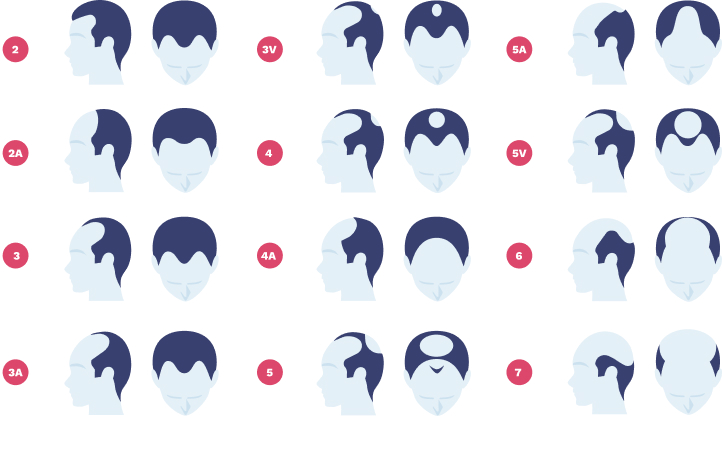
The Norwood Scale is a classification system. It is not a diagnosis, a prediction of how far an individual will eventually progress or a treatment plan. Two men with the same Norwood classification can have very different degrees of miniaturization, donor density, hair caliber, rates of progression and long term treatment needs. The Norwood Scale also does not measure donor quality or identify every pattern of follicular miniaturization. Diffuse thinning involving the traditional donor region can exist outside what the scale depicts. Norwood stage alone should also never determine whether someone is a candidate for hair transplant surgery. Age, progression, donor stability, available lifetime donor supply and the amount of future hair loss that may still occur all need to be considered.The scale describes where a man is today. Responsible long term planning requires considering where his hair loss may be headed.